
How Tech Modernization Projects Fail

___
Every organization runs on three flows hidden in plain sight, hidden only because most leaders never name them.

Work flows through people.
Work flows through process.
Work flows through technology.
Most don't see these three flows as one system. And that's where the trouble starts.
When leaders don't see how these three flows depend on each other, tech modernization projects fail. Research backs this up. Between 60 and 80 percent of technology projects fail to meet their original goals.
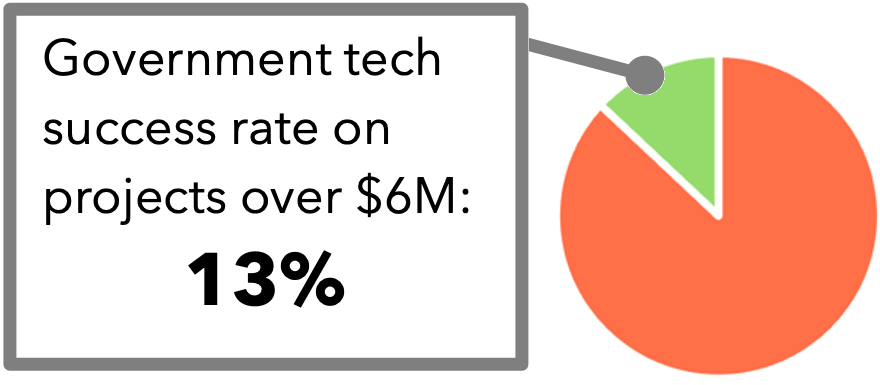
Government projects fare even worse — the Standish Group found that government tech projects over $6 million succeed only 13 percent of the time.
What's striking isn't the failure rate. It's the reason.
Project after project, the culprit isn't the technology. It's the setup: unclear goals,requirements that don't reflect what the work actually needs to do, and operational know-how brought in too late to matter.
The technology delivered what it was asked to deliver. The problem was what it was asked to deliver.
The Wrong Project Gets Built
A modernization project gets approved. Leadership is motivated. IT is brought in,as it should be. IT people bring real strengths to this work — they think in systems, they know what software can and can't do, and their involvement isn't just appropriate, it's essential.
But here's where the setup goes wrong.
A tech modernization project is a business project first. It belongs to the business stakeholders — the leaders and managers who know how the work gets done, and the staff who do it. Their knowledge — the precise, hard-won knowledge of how things really work, where the friction is, what the exceptions are, and what the work needs to do — is the foundation that technical requirements must be built on.
When that foundation is built mostly by IT, even skillfully, something critical is missing. Business stakeholders haven't formally led the project. Front line staff haven't shaped the requirements. The system that gets built reflects a technically sound interpretation of the work — not the work itself.
The executive's job is to change that.
The business owner has a stake broader than the technology project alone. They're accountable for how this project affects vendors, partner agencies, staff, and ultimately the residents or customers the agency serves. The technology may touch all those relationships or just some. Either way, the business owner answers for the outcome. That's why they lead.
When the Flows Come Apart

People, process, and technology aren't three separate things.
They're three flows that form a single system. When they move together in sync, things work. When they come apart — when the flows fall out of sync — things breakdown. The result is a system that may work on paper but doesn't in practice.Workarounds appear. People resist. And the problems that show up six months after go-live were almost always there from the start.
Three Things to Get Right Before Anything Else
The most important question isn't: what system do we need?
It's what does the work need to do, and who in this organization knows enough to answer that?
Three things will get your project off on the right foot.

Name a business owner — someone from outside IT who is accountable for defining what the work needs to do. They lead the business project. IT delivers within it.

Build involvement into the plan from day one. That means business stakeholders at every level: the people affected by the change, the people who do the work, and the people who manage them. Not involving people directly affected by a change is an open door to friction and drag — the kind that shows up mid-project, when it costs the most to fix.

Run a process improvement workshop before any technology is selected or built. Bring business stakeholders and IT together to map how the work gets done today, design a better future state, and build the implementation plan to get there. This is how you automate a better process instead of a broken one — and how you give IT what it needs: clear, business-defined requirements shaped by the people who know the work.
Get these three things right, and the three flows stay aligned from the start — and your project has a far better chance of working.
_____________
For more information, see more about our Tech Modernization services.
Carlos Venegas, principal of Straus Forest LLC, works in collaboration with the Athena Group to help government agencies plan and implement technology modernization projects that are business-driven and people-focused. Contact Carlos: carlos@carlosvenegas.com / 206-919-0960
_____________
Copyright 2026 Carlos Venegas. All rights reserved.

